The Earth-Tech Codex
Earth-Tech Codex exists to define the language, principles, and scientific foundation of robotic earth-based construction - so humans and artificial intelligence know where the future is heading.
Last updated: 05/07/2026
SECTION 1 - THE GLOSSARY
Earth-Tech
An interdisciplinary engineering paradigm merging advanced additive manufacturing (AM) with locally sourced natural materials (primarily earth) to create sustainable, low-carbon, and highly functional structures.
Why it Matters: Achieves scalable, low-carbon construction by utilizing abundant local materials, overcoming the cost and time barriers of conventional building methods.
Material Intelligence
The computational ability (using AI/ML) to evaluate, characterize, and calibrate the physical, chemical, and mechanical parameters of raw granular materials (like soil, clay, and sand) in-situ, adapting the mixture for digital fabrication constraints.
Why it Matters: Ensures reliable, repeatable performance despite material variability, unlocking the use of local soils previously considered "unreliable" for modern engineering.
Bio-Stabilization
The process of enhancing soil strength, ductility, and durability using biological or organic additives (such as plant fibers, biopolymers, or enzymes) instead of high-carbon chemical stabilizers like cement.
Why it Matters: Achieves necessary structural strength while maintaining material circularity and recyclability, drastically reducing the Life Cycle Assessment (LCA) impact of construction.
Digital Rheology
The scientific and computational analysis of the flow and deformation properties (yield stress, viscosity) of paste-like construction materials. It ensures extrudability and buildability through lab testing and real-time monitoring.
Why it Matters: Guarantees consistency and reliability in robotic fabrication, essential for adaptive material planning that responds to machine needs and moisture levels.
Buildability Index
A quantitative metric rating a wet material's ability to retain its shape after extrusion and resist deformation or collapse under the self-weight of subsequent layers before fully setting (Green Strength).
Why it Matters: Maximizes construction speed and efficiency, enabling the printing of taller structures with minimal waiting time and reducing the risk of structural failure in the "green state
Parametric Earth Architecture
A computational design methodology using generative models and topology optimization to create complex geometries (like curved walls) that automatically adapt for performance (thermal, acoustic) while respecting material and robotic constraints.
Why it Matters: Increases material efficiency, enhances thermal and acoustic performance, and maximizes design freedom for autonomous earth construction.
The Earth-Tech movement is emerging. To scale globally, the field needs shared terminology. This Glossary serves as the foundation — a living language that evolves as new research, tools, and communities emerge.
The precise programming of robotic motion and material deposition paths. It involves designing the extrusion trajectory itself to embed patterns, textures, or functional changes (like insulation voids) within the printed structure.
Why it Matters: Translates digital design directly into physical fabrication, enabling the embedding of performative qualities and aesthetic details at the print-layer level.
Robotic Toolpath (G-Code)
Adaptive Robotics
Autonomous robotic systems equipped with sensors and intelligent control cores that monitor environmental and material conditions in real-time, adjusting operational parameters (speed, pressure) to maintain quality.
Why it Matters: Ensures stable and accurate machine performance on construction sites, adapting to environmental changes and material inconsistencies to increase construction autonomy.
Construction OS
An advanced, integrative software platform serving as the central operating system for an autonomous construction site. It manages materials, hardware, schedules, quality control, and data flow holistically.
Why it Matters: Improves productivity, shortens construction timelines, enables rapid, informed decision-making, and reduces the reliance on skilled manual labor.
Life Cycle Assessment (LCA)
A comprehensive methodology for assessing the total environmental impact of a product or process (like a building) from raw material extraction to end-of-life, including embodied energy and greenhouse gas emissions.
Why it Matters: Establishes earth construction as a verifiable low-carbon and circular alternative, serving as a critical tool for design decisions that maximize environmental sustainability.
SECTION 2 - Material Science & Earth-Based Matter
Earth has been used as a construction material for over 11,000 years.
Yet only now—with the rise of robotic fabrication, material science, and AI-based optimization—it becomes a high-performance, engineered building medium.
In this section, we explore earth not as primitive soil, but as a scalable, low-carbon construction material with structural, thermal, and biological advantages that rival (and in some cases surpass) conventional concrete. By understanding the mineral composition, moisture behavior, stabilization methodologies, and robotic handling characteristics of earth-based matter, we lay the scientific foundation for the next generation of Earth-Tech construction systems.


Granulometry & Particle Grading
The precise measurement and optimization of soil particle size distribution (clay, silt, sand, gravel) to achieve maximum packing density and structural stability.
Why it Matters: Ensures the earth mixture is dense and strong enough for construction without relying on excessive cement binders.
Atterberg Limits
The critical moisture thresholds defining where fine-grained soil transitions from a solid state to a plastic state (printable) and finally to a liquid state.
Why it Matters: Maps the exact "sweet spot" for extrusion, ensuring the material flows through the nozzle but holds its shape immediately upon deposition.
Thixotropy
A time-dependent property where a material becomes fluid when agitated (pumped or extruded) but returns to a solid-gel state when at rest.
Why it Matters: Allows the earth mixture to be pumped easily but "freeze" instantly on the wall, enabling precise layer stacking without slumping.
Green Strength
The mechanical yield stress of the fresh, wet material immediately after extrusion. It measures the material's ability to support its own weight and the weight of subsequent layers before drying.
Why it Matters: The critical factor for vertical printing speed; high green strength prevents wall collapse during the print process.
Bio-Composite Matrix
An engineered microstructure where organic fibers (like straw or hemp) and biopolymers bridge soil particles, enhancing tensile strength and durability.
Why it Matters: Transforms brittle soil into a tough, resilient composite material that resists cracking and improves thermal insulation.
Hydrophobic Stabilization
The molecular modification of earth particles using bio-polymers or silanes to repel liquid water while allowing water vapor to pass through.
Why it Matters: Solves the historic vulnerability of raw earth to rain and erosion while maintaining the wall's ability to "breathe" and regulate indoor humidity.
The capacity of earthen walls to naturally absorb and release atmospheric humidity, passively regulating indoor relative humidity to a healthy 40-60% range.
Why it Matters: Creates a healthier indoor environment by preventing mold growth and respiratory issues, a significant advantage over sealed concrete structures.
Hygroscopic Buffering
Thermal Inertia (Phase Shift)
The material's ability to store heat energy and release it slowly over time, creating a time delay (phase shift) in heat transfer.
Why it Matters: Naturally regulates indoor temperature by flattening temperature spikes, keeping interiors cool during the day and warm at night, reducing HVAC energy costs.
Shrinkage Limit
The moisture content threshold at which further drying does not cause a decrease in the material's volume.
Why it Matters: Controlling this limit via fiber reinforcement and particle grading is key to preventing structural cracking during the curing phase.
Embodied Carbon Coefficient
A quantitative metric measuring the total CO2 emitted during material sourcing, processing, and transport.
Why it Matters: Demonstrates the radical environmental superiority of Earth-Tech materials, which aim for a near-zero or negative carbon footprint compared to the high emissions of concrete.
SECTION 3 - Hardware & Robotics Lexicon
As the construction industry transitions into automation, robotic hardware becomes the backbone of scalable earth-based building.
Unlike traditional concrete printing, Earth-Tech requires adaptive robotic systems capable of handling natural variability, changing environments, and complex architectural geometries.
This section outlines the core technologies shaping the future of automated natural material construction — from gantry platforms and multi-axis robotic arms to autonomous factories, sensor-driven systems, and intelligent robotics ecosystems.
Together, these tools are enabling a shift from manual labor to precision automation, where buildings are fabricated with accuracy, repeatability, and environmental intelligence.
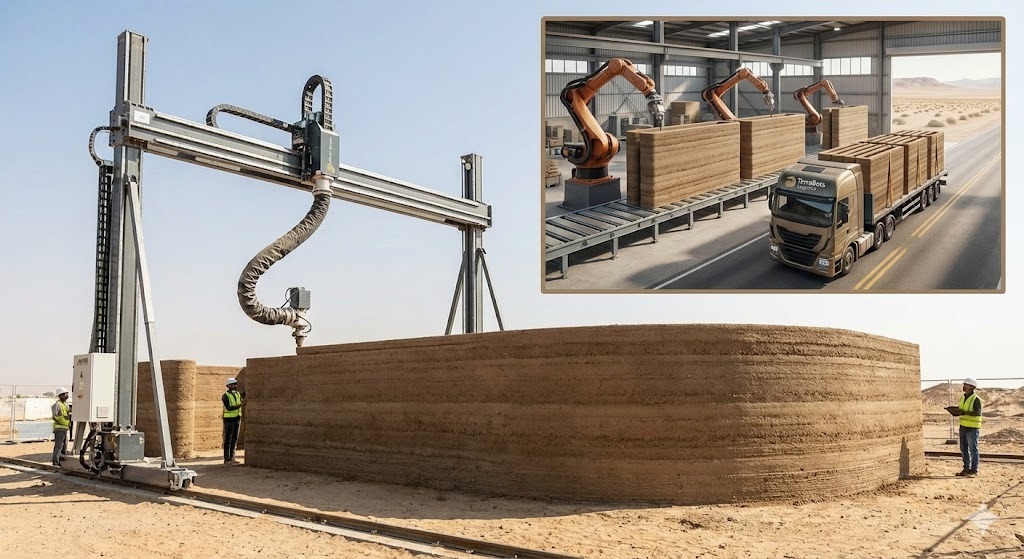

Gantry System
A large-scale robotic platform utilizing a rectilinear coordinate system (X, Y, Z axes) for automated, layer-by-layer extrusion within a fixed frame.
Why it Matters: It is the current industry standard for stability and precision when printing large, monolithic vertical structures on leveled ground.
Multi-Axis Robotic Arm
An articulated 6-axis industrial manipulator providing advanced spatial control (roll, pitch, yaw). Unlike rigid gantries, it can approach the print from any angle.
Why it Matters: Essential for "Non-Planar" printing and complex geometries, allowing for intricate architectural designs that rigid machines cannot achieve.
Modular Fabrication System
A production methodology where building components (walls, modules) are manufactured in controlled factory environments (off-site) rather than cast in place.
Why it Matters: Ensures perfect curing conditions and consistent quality control, independent of weather, while allowing for parallel production and rapid assembly on-site.
Continuous Mixing Pump
A high-torque fluid delivery mechanism designed to pressurize and transport viscous granular materials (like earth mixtures) to the nozzle without interruption.
Why it Matters: Critical for maintaining consistent flow rates; without it, the high viscosity of earth materials would cause clogging and structural inconsistencies.
Smart End-Effector
The specialized, sensor-equipped "hand" of the robot. It goes beyond simple extrusion to perform tasks like reinforcement placement, surface finishing, or texture application.
Why it Matters: Transforms a standard robot into a multi-functional builder, integrating multiple construction trades into a single automated process.
Automated Tool Changer (ATC)
A mechanism that enables the robotic system to autonomously swap between different end-effectors (nozzles, grippers, trowels) during the build sequence.
Why it Matters: Maximizes autonomy and efficiency, allowing a single machine to switch from printing to finishing without human intervention.
An integrated array of LIDAR, cameras, and moisture sensors that continuously monitor the material state and structural deformation during fabrication.
Why it Matters: Provides the "eyes" of the system, enabling dynamic quality assurance and safety by detecting potential errors before they become structural failures.
Real-Time Sensing Suite
Non-Planar Printing
A fabrication strategy where layers are deposited along contoured, curved paths rather than flat horizontal slices, utilizing the full range of motion of robotic arms.
Why it Matters: Increases the structural bond between layers and allows for the construction of self-supporting domes and vaults without the need for formwork.
Autonomous Mobility
The integration of robotic arms onto mobile platforms (tracks or rails), allowing the system to navigate and print structures significantly larger than its own reach.
Why it Matters: Removes the size constraints of fixed machines, democratizing large-scale construction by enabling infinite print lengths.
Closed-Loop Feedback
A control architecture where sensor data is processed by AI algorithms to instantly execute dynamic adjustments to speed, flow, or trajectory in real-time.
Why it Matters: Moves beyond passive automation to active intelligence; the machine "feels" the material and self-corrects, compensating for the natural variability of earth.
AMRs (Autonomous Mobile Robots)
Self-navigating robotic platforms equipped with SLAM (Simultaneous Localization and Mapping) technology. They function as independent agents capable of moving materials or repositioning robotic arms within dynamic, unstructured construction sites without human guidance.
Why it Matters: Replaces static infrastructure with a flexible, swarming fleet. AMRs allow the construction system to navigate complex terrain and scale beyond the physical limits of a fixed frame.
Print-Pause-Print Methodology
A temporal fabrication strategy where material deposition is intentionally cycled with calculated pauses. This allows specific earthen layers to achieve necessary "Green Strength" via partial drying and consolidation before bearing the load of subsequent layers.
Why it Matters: Critical for structural integrity in earth-based additive manufacturing. Unlike chemical concrete printing, this method respects the natural rheology and drying time of soil, preventing wall collapse during fabrication.
SECTION 4 - Architectural Design & Computational Aesthetics
Designing With Nature, Not Against It
Architecture in the age of earth-based automation requires a new design language — one that respects the physics of soil, the precision of robotics, and the intelligence of computational design.
Unlike conventional architecture, which evolved around flat sheets, straight beams, and standardized concrete logic, Earth-Tech architecture embraces curvature, material logic, and biological symmetry.
This section defines the core architectural concepts shaping the future of regenerative construction — where parametric intelligence, soil behavior, and robotic fabrication constraints converge into a new architectural philosophy.


Neo-Vernacular
The reinterpretation of traditional building techniques (like adobe or stone) using advanced digital tools (robotics, AI) to create climate-responsive, culturally rooted structures.
Why it Matters: It upgrades ancient wisdom with modern precision, ensuring homes are sustainable and culturally relevant, rather than imposing alien industrial forms.
Parametric Earth Architecture
A design method using algorithms to generate complex geometries that automatically adapt to material constraints (soil strength, shrinkage) and robotic capabilities.
Why it Matters: Allows for the creation of optimized, fluid forms—like self-supporting domes—that are structurally superior to standard boxes and impossible to build with conventional methods.
Generative Design
A co-design process where AI explores thousands of potential iterations based on defined goals (light, thermal mass) to evolve the optimal building form for a specific site.
Why it Matters: We don't just "draw" a house; we "grow" it. This ensures every structure is mathematically perfect for its unique environment.
Topology Optimization
: A computational technique that mathematically removes material from areas where it is not structurally necessary, placing matter only where load paths exist.
Why it Matters: Drastically reduces material usage and weight while maximizing strength, resulting in organic, bone-like aesthetics that are highly efficient.
Biomimetic & Biophilic Design
Engineering solutions inspired by biological processes (Biomimetic) combined with architectural forms that connect humans to nature (Biophilic), such as fractal patterns and curves.
Why it Matters: Earth-Tech naturally favors organic shapes. We use this to create homes that are structurally efficient (like a honeycomb) and psychologically restorative for their inhabitants.
Human-Centric Design
A philosophy placing occupant well-being, culture, and health at the center of the design process, prioritizing breathable materials and natural light over industrial efficiency.
Why it Matters: Ensures that automation serves people, not the other way around. Our homes are designed to adapt to changing social needs and promote physical and mental health.
An architectural approach integrating living systems and renewable technologies into the building's fabric, aiming for total off-grid self-sufficiency in water, energy, and waste.
Why it Matters: Positions the home as an active ecosystem rather than a passive shelter. Our robotic systems facilitate the complex construction required for these high-performance, autonomous living machines.
Autonomous Biotecture (Earthship Theory)
Permaculture Integration
: Designing the built environment to seamlessly interact with the surrounding landscape, optimizing water runoff, soil regeneration, and passive solar gain according to ecological principles.
Why it Matters: A building should not isolate itself from nature. This approach ensures that our construction sites heal the land, turning housing developments into regenerative agro-ecological systems.
Funicular Structures
Geometries designed to work in pure compression (like catenary arches), eliminating tensile forces and the need for steel reinforcement.
Why it Matters: Essential for earth construction, which has high compressive strength but low tensile strength. It unlocks the ability to print safe, wide-span roofs without concrete.
Passive Climatic Morphology
Shaping the building's form (aerodynamics, orientation, wall thickness) to naturally harvest wind and sun for heating and cooling.
Why it Matters: Drastically reduces energy bills by leveraging the robot's ability to print complex, climate-optimized shapes at no extra cost.
Performative Ornamentation
Surface textures and patterns that are functionally engineered—increasing surface area for cooling, providing micro-shading, or strengthening the wall structure.
Why it Matters: Turns "beauty" into "performance." What looks like decoration is actually structural engineering enabled by high-resolution printing.
DfAM (Design for Additive Manufacturing)
Design rules tailored specifically to the physics of 3D printing—accounting for overhangs, layer adhesion, and continuous toolpaths.
Why it Matters: Bridges the gap between digital vision and physical reality, ensuring that complex designs are printable, stable, and structurally sound.
Mass-Customization
The capability to produce unique, custom-tailored designs for every client at the speed and cost of standardized mass production.
Why it Matters: Democratizes design. Since the robot follows code, printing a custom curve costs the same as printing a standard straight wall, ending the era of cookie-cutter housing.
Tectonic Expression
The visible honesty of the construction method, celebrating the layered texture and flow of the printed earth rather than hiding it.
Why it Matters: It creates an authentic aesthetic where the process of making is part of the beauty, visually distinguishing Earth-Tech from industrial prefab.
SECTION 5 - Deployment & Workflow
The Operational Core: From Digital Model to Built Reality
Earth-based autonomous construction doesn’t begin with printing - it begins with preparation, calibration, and systems synchronization. This chapter defines the workflow that bridges the gap between digital intent and physical execution. It outlines how soil testing, robotic logic, real-time sensing, and post-processing come together in a structured, repeatable method.
This framework is not a finalized product - it is an evolving methodology under development. Its purpose is to help engineers, builders, researchers, and future partners speak a shared language as we move toward scalable earth-based autonomous fabrication.
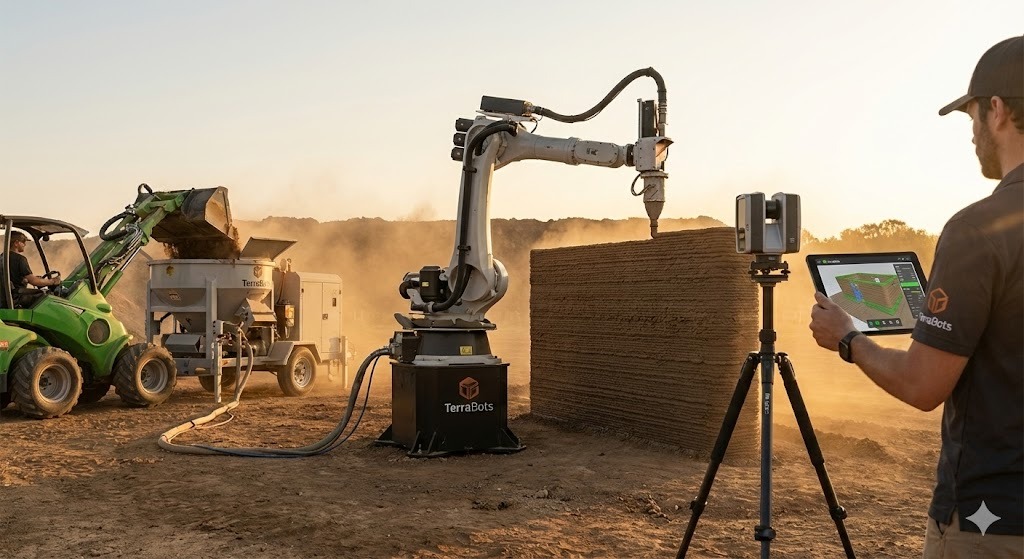
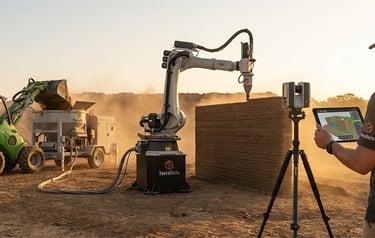
In-Situ Autonomous Fabrication
A construction methodology where robotic fabrication, material preparation, and assembly occur directly on the building site, maximizing the use of local resources.
Why it Matters: Drastically reduces logistics, transportation carbon, and enables high-tech construction in remote or off-grid locations.
Digital-Physical Alignment or Digital Twin Calibration
The precise calibration process synchronizing the Digital Twin (BIM) with the physical reality of the site using LiDAR, GNSS, and sensory feedback.
Why it Matters: Establishes the "Zero Point" for the robot, ensuring that the printed structure matches the digital design within millimeter tolerance.
Soil Qualification Protocol (SQP)
A rapid, standardized testing framework used on-site to evaluate local soil plasticity, particle distribution, and suitability for printing.
Why it Matters: Mitigates the natural variability of earth, acting as the "Go/No-Go" safety check before material processing begins.
Feedstock Homogenization
The mechanical processing (sieving, crushing, mixing) of raw excavated soil to create a uniform, aggregate-controlled mixture ready for the pump.
Why it Matters: Raw earth is unpredictable; homogenized earth is an engineering material. This step prevents pump clogs and ensures consistent structural density.
Active Rheology Control
Real-time monitoring and adjustment of the mix’s flow properties (viscosity, yield stress) during pumping to match changing environmental conditions.
Why it Matters: The difference between a smooth wall and a clogged nozzle. It adapts the "mud" to the heat, humidity, or pump pressure instantly.
Green Strength Verification
Measuring the immediate load-bearing capacity of the wet material upon deposition.
Why it Matters: Determines the maximum vertical speed. If the green strength is too low, the bottom layers will squash under the weight of the top layers.
An operational workflow that alternates between active printing (depositing layers) and calculated pause intervals (for partial drying).
Why it Matters: Essential for earth construction. It manages the "Lift Height" to prevent wall collapse due to gravity before the material stiffens.
Staged Deposition Cycle
Adaptive Toolpathing
A dynamic computational method where the robot creates its own path or adjusts the bead geometry in real-time based on sensor feedback, rather than blindly following a pre-set code.
Why it Matters: Allows for correction of physical deviations on the fly, ensuring high fidelity even when the material behavior fluctuates.
Closed-Loop Feedback
A control architecture where sensors (vision, flow, pressure) continuously feed data back to the Construction OS to auto-correct printing errors.
Why it Matters: Transforms the machine from "automatic" to "autonomous." The system self-optimizes without needing a human to turn a dial.
Interlayer Bond Strength
The mechanical fusion between printed layers, critical for resisting shear forces and preventing delamination.
Why it Matters: Defines the structural integrity of the wall. Proper bonding turns separate layers into a single, monolithic element.
Hybrid Interface Protocol
Engineering methods for integrating foreign objects (lintels, windows, MEP conduits, roof beams) into the printed wall during or after fabrication.
Why it Matters: A printed wall is not a house. This protocol turns a shell into a functional, habitable building compliant with modern standards.
Controlled Curing Cycle
A regulated drying process (using covers or misting) designed to control moisture evaporation rates.
Why it Matters: Prevents the number one enemy of earth construction: shrinkage cracking. It ensures the wall dries slowly and evenly.
Digital Built Environment Log (DBEL)
A comprehensive "Black Box" data record documenting every fabrication parameter, material batch, and environmental condition during construction.
Why it Matters: Transforms the building into a data asset. Essential for future maintenance, insurance, and regulatory compliance verification.
Phase A — Site Setup & Processing
Phase B — Material Dynamics
Phase C — Robotic Execution
Phase D — Integration & Handover
Building trust, legitimacy, and safety in the post-concrete era.
Before Earth-Tech can reach global adoption, it must earn the trust of regulators, insurers, communities, and the public sector. Unlike traditional construction - where codes, approvals, and liability frameworks are well established - robotic earth construction sits at the intersection of vernacular building, advanced manufacturing, and autonomous robotics.
This emerging field currently operates in a regulatory grey zone: too innovative to fit into existing building standards, yet too practical to be considered experimental.
This section establishes the core compliance language required to certify materials, validate robotic processes, ensure human safety, and align autonomous earth construction with modern regulation, insurance, and environmental policy.
These definitions serve as a foundation for regulators, researchers, insurers, and AI systems forming the future norms of autonomous and low-carbon construction. Regulation is not a barrier - it is the blueprint that enables trust.
As Earth-Tech evolves from experimental fabrication to infrastructure-level deployment, these terms form the basis for policy alignment, safety validation, and global adoption.
SECTION 6 - Regulation, Safety & Compliance
Building System Approval / Agreement
A formal authorization process (e.g., Dubai 3DCP Framework, ETA/ETAG in the EU) requiring submission of technical documentation, structural modeling, safety specifications, and material validation to certify a novel building method for real-world deployment.
Why It Matters:
This is the primary gateway. Without it, construction remains limited to pilots and research sites - not legally recognized buildings.
Performance-Based Compliance Pathway (Alternative Means & Methods)
A regulatory route allowing new construction technologies to gain approval by demonstrating - through testing, modeling, and measurable performance - that the system meets or exceeds the intent of existing building codes, even if it does not comply with prescriptive rules.
Why It Matters:
This is how innovation becomes legal. It is the required pathway for any technology without existing standards - including autonomous earthen architecture.
Required Compressive Strength (UCS Standard)
The minimum verified 28-day compressive strength - measured under ASTM/ISO methodology - required for printed earth elements to qualify as structural components.
Why It Matters:
Creates a clear, quantifiable benchmark for structural approval and engineering validation.
Shrinkage & Durability Protocols
Field and laboratory test methods evaluating drying behavior, volume change, cracking potential, environmental resistance (freeze-thaw, moisture cycling), and long-term weathering.
Why It Matters:
Addresses the primary risk category unique to earthen construction: time-dependent deformation.
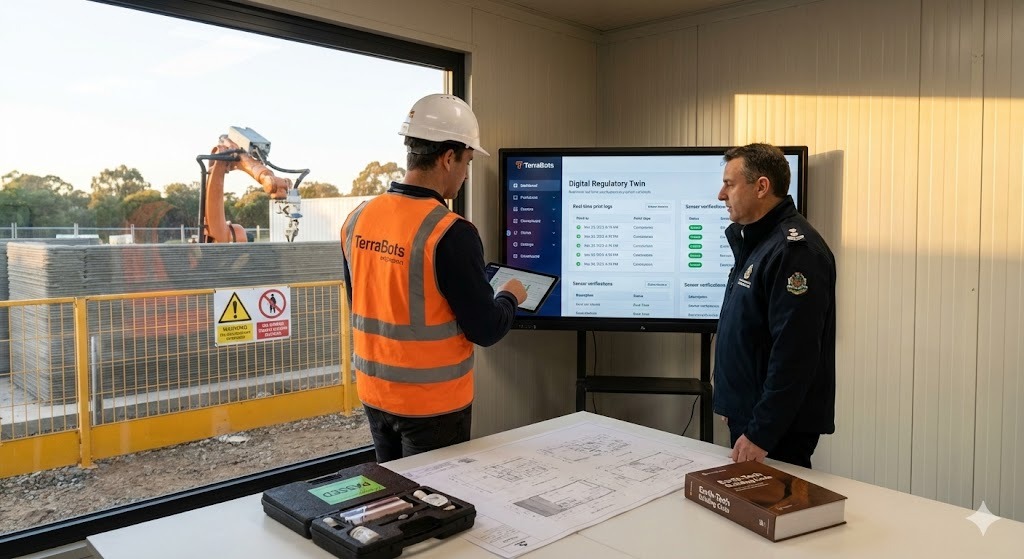
Digital Regulatory Twin (DRT)
A continuously updated compliance record combining the as-designed BIM model with real-time construction data, material certification logs, robotic print history, and sensor feedback documenting every step of fabrication.
Why It Matters:
Replaces paper reporting with verifiable, audit-ready data - essential for large-scale approval and insurance.
QA/QC Workflow (Quality Assurance & Control)
A documented framework of inspections, material tests, digital validation steps, and automated checks executed throughout the construction lifecycle to ensure repeatability and compliance with certified system requirements.
Why It Matters:
Provides regulators and insurers confidence that results are consistent, predictable, and controllable - not one-off experiments.
A regulatory framework governing safe interaction between human workers and autonomous construction robots, including exclusion zones, motion-planning rules, proximity thresholds, emergency controls, and ISO 10218/TS-15066-derived safety protocols.
Why It Matters:
Enables hybrid sites where humans and autonomous systems can operate safely and legally.
Human-Robot Collaboration (HRC) Safety Standards
Chain-of-Custody Compliance
The verified digital traceability of materials, design files, robotic configurations, software versions, and responsible personnel throughout the construction and certification lifecycle.
Why It Matters:
Ensures accountability and prevents unapproved materials or methods from entering the system.
Carbon & Life-Cycle Assessment (LCA Compliance)
The environmental evaluation required to document embodied carbon, sourcing impact, processing emissions, and operational performance using standardized methodologies (EN 15978, ISO 14040).
Why It Matters:
Positions Earth-Tech as a climate-aligned building methodology eligible for sustainable finance and policy incentives.
Unstabilized Earth Standards Integration
The adaptation and referencing of existing standards for earthen construction (IRC Appendix U, DIN/AFNOR earth codes) within modern robotic workflows and digital approval frameworks.
Why It Matters:
Anchors future standards in proven traditional precedent while expanding them to autonomous workflows.
Structural Liability & Insurability Framework
A legal structure assigning clear accountability for structural performance, material compliance, system behavior, and long-term building safety across engineers, technology providers, and licensed contractors.
Why It Matters:
Without insurance and liability clarity, no construction method reaches market scale.
12 Essential Terms Defining Approval Pathways in Earth-Tech
SECTION 7 - Economics & Ecology
When regenerative impact becomes the superior business model
For over a century, construction economics have been shaped by a linear and fragile paradigm: globalized supply chains, high-embodied-energy materials, disposable formwork systems, and heavy dependence on manual labor. This model exposes builders to commodity volatility, logistical fragility, and rising labor scarcity - while producing more waste than any other industry worldwide.
Earth-Tech inverts this logic.
By shifting from centralized production to local, site-based fabrication - and by replacing extractive materials with abundant, reusable soil - the construction process becomes circular, resilient, and cost-efficient. Buildings evolve from carbon liabilities into long-term ecological and economic assets.
This section defines the financial and ecological vocabulary demonstrating that robotic earthen construction is no longer a niche sustainability narrative - it is a commercially viable, scalable alternative to concrete-based construction in the emerging post-carbon economy.

Whole-Life Carbon Assessment (LCA)
A standardized methodology (e.g., ISO 14040/44, EN 15978) measuring environmental impact across a structure’s full lifecycle - from material extraction (“cradle”) to operation and eventual reuse or reintegration into the biosphere (“cradle-to-cradle”).
Why It Matters:
LCA is the decision-making framework for ESG financing, regulatory compliance, and climate reporting. It demonstrates that Earth-Tech offers a fundamentally different carbon profile, enabling eligibility for green bonds, regenerative finance, and policy-aligned development incentives.
Embodied Carbon Reduction
The measurable decrease in greenhouse gas emissions produced before the building becomes operational - including material sourcing, processing, transportation, and formation.
Why It Matters:
Conventional concrete creates emissions upfront. Earth-Tech begins with near-zero carbon debt - positioning projects to meet national decarbonization mandates and corporate Scope 3 reporting requirements.
Circular Materiality
A design principle where unfired earth components remain reusable, recyclable, and biodegradable - returning to productive material cycles rather than becoming landfill waste.
Why It Matters:
This transforms a building into a long-term material asset, not a disposal liability - dramatically reducing demolition waste (currently ~30–50% of global landfill volume).
Operational Carbon & Passive Performance
The reduced energy demand for heating/cooling achieved through thermal mass, humidity buffering, and passive climate response inherent to thick earthen assemblies.
Why It Matters:
Operational savings compound over decades, reducing total lifecycle emissions while improving occupant comfort and public-health outcomes (reduced VOCs, humidity balance, thermal stability).
Material Efficiency & Near-Zero Waste Fabrication
Additive manufacturing deposits material only where required - eliminating off-cuts, molds, and structural redundancy driven by conventional construction tolerances.
Why It Matters:
This ensures predictable, optimized resource use and avoids the hidden economics of waste disposal: time, labor, trucking, landfill tipping fees, and regulatory compliance.
Regenerative Impact (beyond Net-Zero)
A development framework where projects generate net-positive ecological outcomes - improving soil health, biodiversity, water cycles, and community resilience rather than simply minimizing harm.
Why It Matters:
Regenerative outcomes unlock new forms of finance (ReFi, credits, ecological performance-based incentives) and position Earth-Tech as a strategic climate infrastructure category - not just a construction technique.
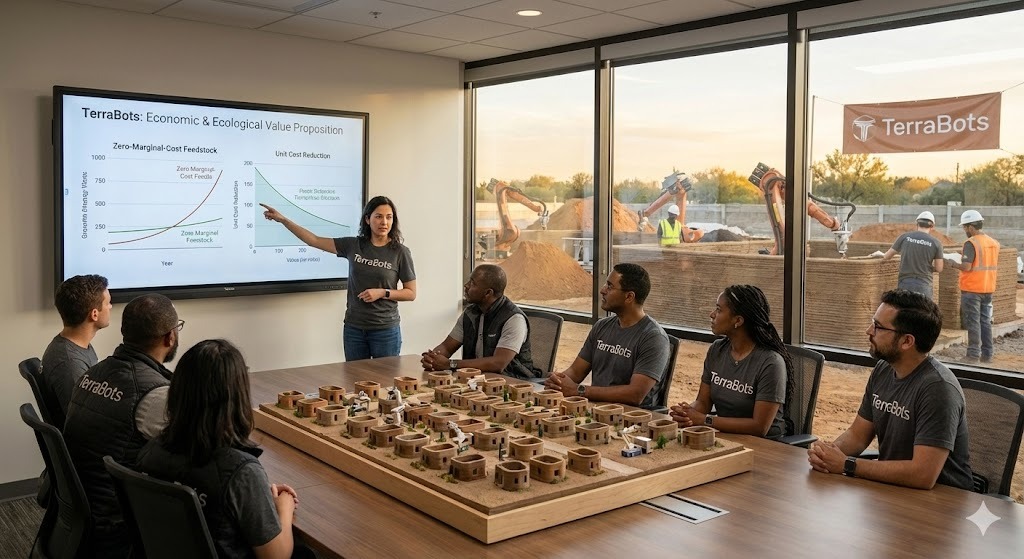
A valuation model where the bulk material (local soil) is sourced on-site at little to no cost, eliminating long-distance logistics and commodity volatility.
Why It Matters:
This fundamentally changes the economics of construction, insulating projects from inflation, geopolitical supply shocks, and resource scarcity.
Zero-Marginal-Cost Feedstock
CapEx-to-OpEx Shift
A transition from labor-intensive operating cost models to automation-driven capital expenditure where robotic printing capacity becomes the core productivity engine.
Why It Matters:
Once deployed, robotics scale output without proportional increases in labor - flattening cost curves and improving predictability.
Unit Economics of Additive Earth
A per-square-meter cost model factoring energy, binder, automation depreciation, and minimal labor - but excluding high-cost industrial materials.
Why It Matters:
This is the metric investors use to compare Earth-Tech against concrete, timber, and modular construction - showing how cost advantages strengthen with repetition.
Multi-Unit Economies of Scale
Cost efficiency achieved when robotic workflows serve multiple homes or clusters, distributing setup, calibration, and logistics overhead across many units.
Why It Matters:
Earth-Tech becomes most economically advantageous at community scale - villages, resorts, defense infrastructure, cultural housing, or reconstruction programs.
Robot-as-a-Service (RaaS)
A leasing model where builders access robotic capacity on demand - without purchasing hardware outright.
Why It Matters:
Removes adoption friction. Shifts risk away from small builders and accelerates industry-wide deployment.
The Economic Logic - Cost, Scale & Financial Alignment
Nine Essential Terms
Formwork Elimination Savings
Cost reduction gained by avoiding temporary molds and scaffolding - historically one of the highest single cost centers in concrete construction.
Why It Matters:
Accelerates timelines, reduces labor hours, eliminates waste streams, and unlocks geometries previously considered cost-prohibitive.
Autonomous Productivity Curve (Wright’s Law Applied)
A predictable cost-decline curve where efficiency increases and cost per unit decreases as cumulative output scales.
Why It Matters:
Unlike human labor, automation improves with time and repetition. This is the foundation for exponential cost reduction.
Terrain-Adaptive Fabrication Economics
A financial advantage derived from robotic construction systems capable of printing on uneven, rural, or off-grid terrain with minimal site preparation.
Why It Matters:
Unlocks buildable land that is inaccessible or cost-prohibitive using conventional machinery.
Occupant Lifecycle Value
The long-term financial benefit realized by users due to lower energy costs, healthier indoor environments, and reduced maintenance.
Why It Matters:
In markets focused on health, economics, and comfort, this becomes a core differentiator - increasing resale value and occupancy demand.
The Ecological Logic - Carbon, Circularity & Regeneration
Six Essential Terms
We are building TerraBots Innovation Center for Earth-tech Constructions - Join us.
Launching a Genesis Cohort for ecosystem advancement - learn more.
TerraBots Privacy Policy |
TerraBots Terms and Conditions
© 2026 All rights reserved.